Black Mass Energies Surpasses ₹2 Cr Revenue in FY26, Opens Seed Round for FY27 Expansion

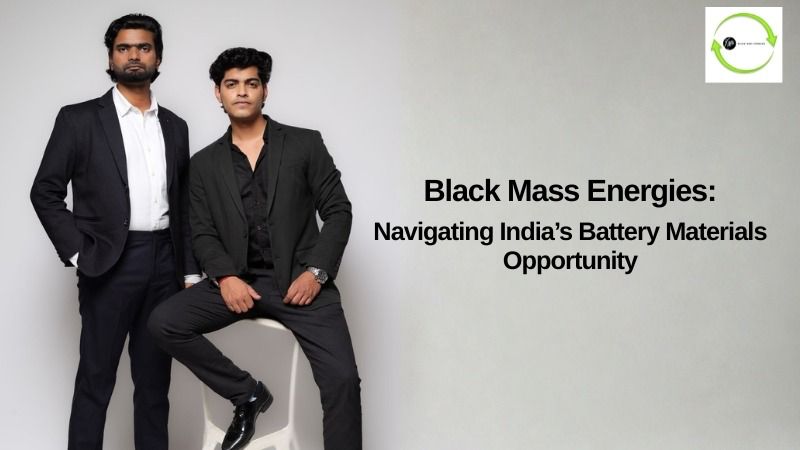
Founded in June 2024 by Shivam Kumar Gupta and Shashank Chaurasia, Black Mass Energies Pvt. Ltd. is part of India’s emerging battery recycling and critical materials sector. The company has reported revenue of over ₹2 crore in FY26 within its first two years, indicating early participation in a rapidly expanding global market.
The rise of companies like Black Mass Energies is directly linked to a larger global shift. As electric vehicles and energy storage systems scale rapidly, the demand for lithium, cobalt, nickel, and other battery-grade materials is increasing at an unprecedented pace.
Global and Domestic Market Dynamics
The global lithium-ion battery recycling market is projected to exceed $35–40 billion by 2030, making it one of the fastest-growing sectors in the clean energy space. China currently dominates this industry, controlling a significant share of refining capacity and recycling infrastructure, while Europe and the United States are rapidly investing to build their own localised supply chains.
India, however, is still at an early stage, which presents both a challenge and a huge opportunity. With EV adoption accelerating, the country is expected to generate a significant volume of lithium-ion battery waste by 2030. Yet, large-scale refining and recycling infrastructure remains limited, leading to underutilization of valuable materials and loss of economic value through exports.
The Strategic Importance of Black Mass
Black mass, the intermediate product derived from used lithium-ion batteries, contains high-value metals such as lithium, cobalt, nickel, manganese, and graphite. Along with this, critical battery metals and rare earth elements are becoming strategically important resources, with countries treating them as the backbone of future energy security.
Black Mass Energies is solving this gap by building a strong trading and aggregation network for black mass, critical metals, and rare earth materials, connecting domestic suppliers with global buyers. This approach enables immediate value creation while strengthening supply chains for future expansion.
R&D and Ambitious Scaling Targets
At the same time, the company is investing in R&D to develop next-generation hydrometallurgical processes, particularly focused on refining LFP black mass, which is expected to dominate the EV battery segment in the coming years.
Founder & CEO Shivam Kumar Gupta said the company is now focused on aggressive scale, aiming to reach ₹25 crore in revenue in FY27 as demand for critical battery materials continues to rise. Co-founder Shashank Chaurasia added that the company is expanding rapidly and plans to onboard multiple new B2B clients in the current financial year, further strengthening its market presence.
Long-Term Vision and Sector Challenges
The long-term vision is to ensure that once critical battery materials enter India, they remain within the ecosystem. By refining and reusing these materials domestically instead of exporting them, the country can reduce import dependency, lower battery costs, and build a self-reliant EV supply chain.
However, the sector still faces challenges such as unorganized battery collection systems, high capital requirements for refining plants, evolving regulations, and technological limitations in efficiently extracting materials, especially from LFP batteries. Global competition remains strong, with established players already operating at scale. Despite this, the opportunity ahead is massive. The shift toward electric mobility, renewable energy storage, and circular economy models is inevitable. Companies that can combine supply chain control, technological innovation, and scalability will play a defining role in shaping the future of this industry.
Establishing a Key Industry Presence
With early traction, growing revenues, and a clear strategy, Black Mass Energies is positioning itself as a key player in India’s battery materials ecosystem, contributing to both economic growth and a more sustainable energy future.
Also Read: Exploring Battery Modelling and Simulation Using Data and AI
Subscribe & Stay Informed
Subscribe today for free and stay on top of latest developments in EV domain.