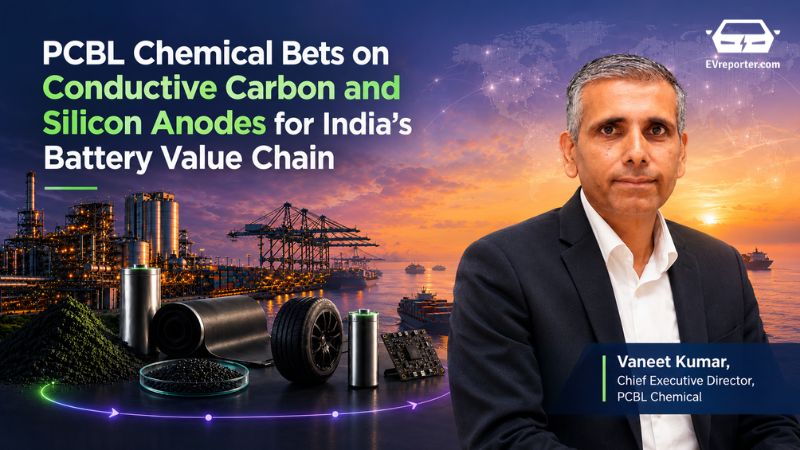
PCBL Chemical Bets on Conductive Carbon and Silicon Anodes for India’s Battery Value Chain

Headquartered in Kolkata, PCBL is a part of the RP-Sanjiv Goenka Group. In this conversation with Mr. Vaneet Kumar, Chief Executive Director, PCBL Chemical, we discuss their approach to building a battery materials business in India.
Please give us a macro-level view of PCBL and its focus on battery materials.
PCBL has three main platforms. The first is our legacy product line, Carbon Black, which goes into rubber and some specialty segments. The second platform, acquired a few years ago, is Aquapharm — again a specialty business, but beyond carbon black, serving areas like water treatment. The third platform is Conductive and Advanced Materials, which is where battery materials sit.
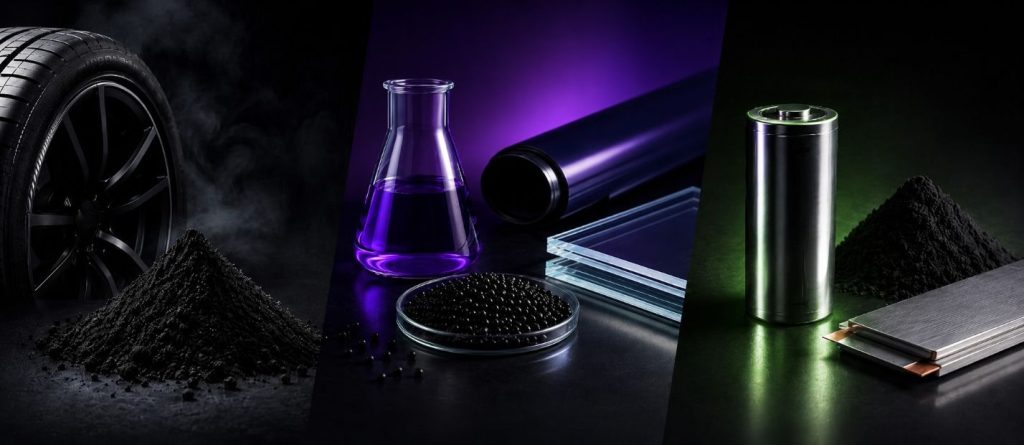
Within battery materials, we have started with two material platforms, Carbon & Silicon, with an ambition to become a multi-platform player.
- On carbon, we work with conductive carbon, which goes into all cell chemistries — LFP, NMC — as well as dry batteries and lead-acid batteries. Within carbon, we have two products: Superconductive Black (ready for qualification) & Acetylene Black, i.e., the purest form of carbon black. To further expand the carbon platform, we’re also developing a solution that mixes carbon with CNTs (carbon nanotubes).
- Looking ahead to future battery chemistries, we are focused on silicon materials developed with an Australian technology partner. Today, artificial graphite blended with natural graphite is the standard anode material, and it has largely reached its practical capacity ceiling. Silicon’s capacity is five to six times that of artificial graphite, which offers a real opportunity to improve overall battery energy density. Silicon is a complex material that requires specialized formulation and solutioning. Our current material is pure silicon, and we’re expanding into silicon-carbon. Pure silicon acts as a precursor to silicon-carbon, whereas silicon-carbon is the mainstream silicon material that can be dropped directly into battery manufacturing.
For the conductive carbon black platform — can you help explain its role in a battery?
Carbon provides ionic conductivity to the battery. As charging expectations have moved from roughly 4-hour charging to 15-minute charging, high-conductivity carbon additives have helped make that possible. On the active-material side, we have cathode materials like LFP and NMC, and on the anode side, artificial graphite. Carbon is mixed with these active materials to act as a conductive agent, helping lithium ions move between anode and cathode.
Physically, this forms a carbon matrix — created when the carbon black is mixed with the anode or cathode material together with a binder — and this matrix structure is what provides ionic conductivity within the active material.
Who are your customers for this product?
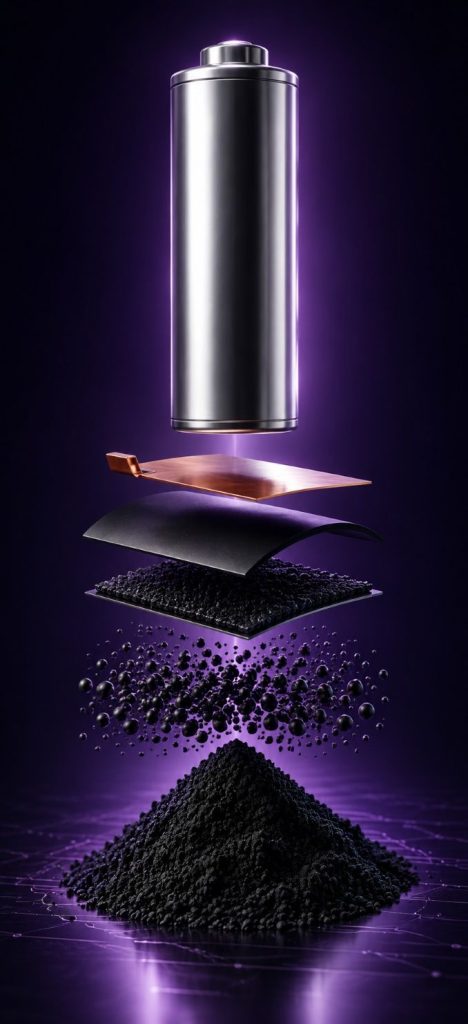
Our customers are cell manufacturers — they use both Acetylene Black and Superconductive Black directly. Lithium-ion battery makers are our largest customer segment by far, but these materials also go into non-battery applications and other battery types like dry batteries and lead-acid batteries. Carbon is also used as a conductive additive in wires, cables, plastics, and specialty coatings.
What’s the current readiness level of your carbon products for cell manufacturing?
For Superconductive Black, we have a commercial-scale line set in Palej, Gujarat, with a capacity of about 1,000 MTA. We use this for customer qualification—samples are already with customers. We’re close to qualification for lead-acid and dry-battery applications, as most technical challenges are resolved. For lithium-ion, we’re still working to improve material purity—it’s a continuous cycle of trials, testing, and customer qualification that takes a few months each round. Our most recent trial was in August, and we’re waiting on results now.
Acetylene Black is still at the project stage — we’re just starting in Mundra, and the plant should be ready by the middle of next financial year.
There was a recent announcement about approval under the ECMS scheme for your Acetylene Black project. Can you explain what that approval entails?
It is a subsidy typically given to electronics component manufacturers — this is, I believe, the first time it’s been extended to a material supplier. Two material suppliers in the lithium battery space received it: us and Epsilon.
Under this, we get up to 20% subsidy on capital investment for our Acetylene Black lines, against a planned capital investment of around ₹329 crore across different phases. We’ll be engaging with the government to access this support.
This matters because Acetylene Black is produced in China at massive scale, and they’ve built significant overcapacity — so there’s a real risk they could undercut on price. We are also seeking additional support to build out the domestic value chain as an integral part of the overall battery materials supply chain—that kind of domestic value addition really only becomes viable with duty support structures and capital subsidy incentives in place.
Acetylene Black versus Superconductive Black. These are two different products on the carbon platform — can you explain the different capabilities of each?
They’re both carbon black products, but differ significantly in conductivity level and surface area.
- Superconductive Black has the highest conductivity and suits applications that need very fast charging or where the medium itself has slower inherent conductivity—for example, supercapacitors or dry batteries, and some fast-charging mobile-phone applications. Because it has very high surface area, it’s genuinely difficult to disperse into a slurry and mix with other active materials.
- Acetylene Black is the more mainstream carbon black — lower conductivity than Superconductive Black, with a surface area comparable to Super P, the industry benchmark for battery-grade carbon black. It’s also purer because the manufacturing process is different: Acetylene Black is produced from acetylene gas, while Superconductive Black still uses carbon-based feedstocks.
What’s the base source material for both platforms?
Acetylene Black is based on acetylene gas, produced from calcium carbide — a material widely available in India and used across industries, including batteries. Superconductive Black uses a carbon-based feedstock — CBFS (carbon black feedstock oil), a byproduct available domestically as well as through global supply chains.
On the silicon side, we use silica, which is also locally available in India.
Other global initiatives are working on silicon anode supplementation. What’s your technology differentiator?
We have unique, proprietary IP here, developed with our Australian technology partner, which gives us a key advantage. Traditionally, there are two methods used to produce silicon-carbon: the silane-gas-based chemical vapor deposition (CVD) route, which has seen the widest adoption, and the milling method, where larger silicon particles are mechanically broken down.
Instead, we use a chemical reduction process. This gives us a lower-cost route than silane-based CVD and higher-quality output than the milling method—performance comparable to silane plus CVD, but at a lower cost and faster to scale.
We’re setting up a 50-metric-ton silicon facility, targeting completion this quarter, with customer sampling starting next quarter. Lithium battery manufacturers typically take six months to a year to qualify a new material, so post-qualification we’d look to use the same line for commercial supply of pure silicon. Longer-term, we’re planning an integrated facility for both nano-silicon and silicon-carbon.
Silicon is used in a few different forms blended with artificial graphite. There’s SiOx (silicon-oxygen), which is already commercialized in some niche EV applications — it’s the most common way silicon is used today, though it only raises anode capacity by around 10–15%, not much beyond that.
The next tier is pure silicon, which has real technical challenges around expansion/swelling and conductivity — used in its purest form, it creates cycling (cycle-life) challenges. Cell manufacturers can technically use it directly, but it won’t deliver the cycle life they want.
The standard way to address this is to mix or coat it with carbon— what’s called silicon-carbon or a silicon-carbon composite. This becomes a stronger material that can deliver cycle life comparable to graphite/artificial graphite, with only an acceptable, modest reduction.
That’s why most players working on silicon anodes are focused on either SiOx or silicon-carbon. Pure silicon in its purest form is really only suited to high-end applications like aerial vehicles, where energy density matters more than cycle life. Silicon-carbon, by contrast, is what goes into mainstream electric vehicles.
We’ll make both — pure silicon and silicon-carbon. For pure silicon, we’re developing a proprietary formulation that cell manufacturers can use directly.
Across both the carbon-based and silicon-based platforms, what percentage of a cell’s bill of materials (BOM) could you capture?
On the cathode side, carbon makes up 2–3% by weight; with CNT blended in, that can vary slightly, but 2–3% is typical. On the anode side, it’s slightly higher — up to around 5% in some applications. Combined, carbon typically accounts for about 2–3% of total cell weight.
For silicon, blended with artificial graphite on the anode side, typical concentrations are 5%, 10%, and 15%, with some applications pushing toward 20–25%. At 5–10% silicon content, you’d see a broadly comparable share by weight.
Neither material is used in large quantities. While silicon is a very high-value material, conductive carbon is more mainstream and high-volume.
For your carbon and silicon platforms, do you source your feedstock locally?
Not entirely. In some cases, we already use local feedstock; in others, impurity levels are still a challenge and we’re working to improve that. Where local purification technology isn’t yet in place, we also rely on imported feedstock.
That’s also true for our core carbon black business, where a large share of feedstock is domestic, but we still import some.
What’s your view on the viability of Na-ion batteries for low-speed or less demanding electric mobility applications? And are any of your product lines relevant to these emerging chemistries?
Sodium-ion is a promising alternative to lithium-based batteries. You can build a sodium-ion battery without lithium, cobalt, or even nickel. That said, sodium-ion still lags lithium-based batteries on energy density. Continuous improvement is happening — one cathode chemistry has reached energy density on par with LFP, though that chemistry still relies on nickel and manganese. If we could get a chemistry with the same locally available material base and LFP-comparable energy density, I see strong potential to grow the sodium-ion business.
Today, LFP reaches roughly 180 watt-hours/kg, while NFPP — the sodium-ion equivalent of LFP — is around 120–130 watt-hours/kg. That energy density gap makes it currently unviable for mainstream EVs, since it can’t deliver the range customers now expect. But India has many use cases that don’t need long range — last-mile delivery, connectivity vehicles, low-speed vehicles — and sodium-ion could be a viable option there once it becomes commercially competitive. Right now, cost is high mainly because of limited production scale, not the underlying material cost. I do believe in this technology, and I think India should actively develop this platform.
On PCBL’s side, we’re actively evaluating what role we could play in sodium-ion. One initial area of assessment is hard carbon as an entry route into sodium-ion. We’re also looking at cathode possibilities.
For PCBL, our selection criteria for any new material segment come down to two things: first, it needs a sustainable, local supply chain — that’s how we chose silicon and carbon — and second, we look for segments that aren’t already highly concentrated or hyper-competitive, where there’s a genuine opportunity to grow as a global supplier.
Also read: Epsilon acquires German LFP Cathode Tech Center | Plans to establish manufacturing plant in India
Subscribe & Stay Informed
Subscribe today for free and stay on top of latest developments in EV domain.