IP67 vs IP68 in EV Connectors: What it actually means in real-world conditions

Every EV that rolls off a production line carries hundreds of electrical connectors. Some are tucked safely inside the cabin. Others sit exposed to monsoon rain, road splash, underbody pressure wash, and the relentless heat of Indian summers. The connectors themselves get a lot of engineering attention, but the rubber seals inside them — the components that actually keep water out — are rarely discussed outside the wiring harness community.
This article explains what IP67 and IP68 protection ratings really mean for EV connector sealing, why the distinction matters more in electric vehicles than it ever did in ICE vehicles, and what engineers and procurement teams should look for when specifying connector seals for EV applications.
What do IP67 and IP68 actually test?
The IP (Ingress Protection) code, defined by IEC 60529, is a two-digit rating system. The first digit rates solid particle protection (dust), and the second digit rates water protection. Both IP67 and IP68 share a first digit of 6, meaning complete dust-tightness — no ingress of dust whatsoever under sustained low-pressure conditions.
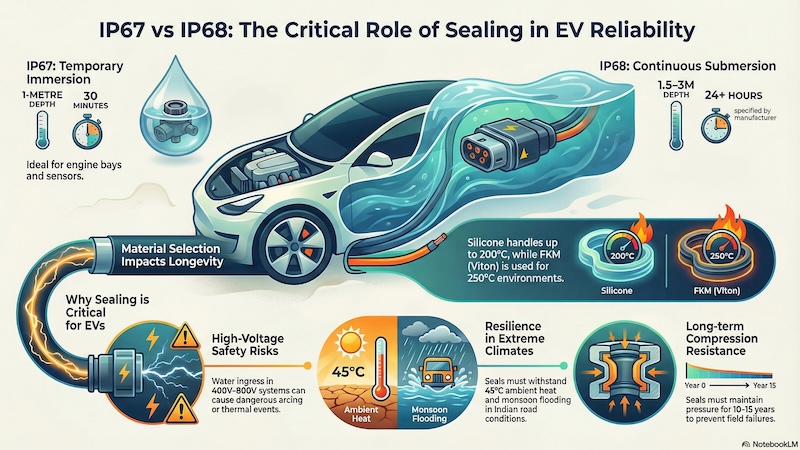
The difference lies in the second digit, and this is where things get interesting for EV applications:
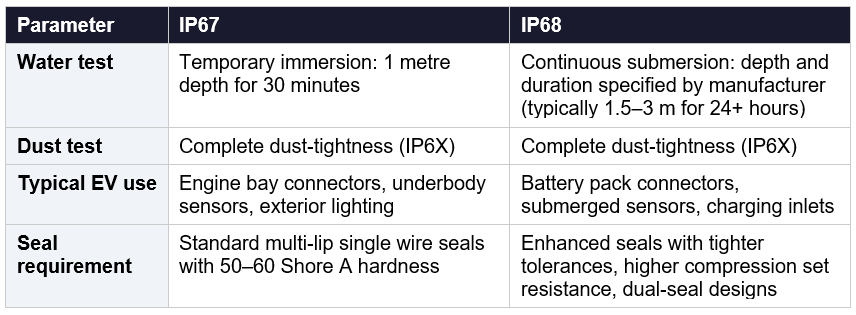
There is also IP6K9K, which tests resistance to high-pressure, high-temperature water jets (80°C at 80–100 bar). This is increasingly specified for underbody connectors on EVs that will be exposed to commercial wash bays or pressure cleaning.
Why does this matter more for EVs than ICE vehicles?
In a conventional ICE vehicle, a connector failure due to water ingress might cause a warning light or a malfunctioning sensor. Inconvenient, but rarely dangerous. In an EV, the stakes are fundamentally different.
Battery pack connectors operate at voltages between 400V and 800V in modern EVs. Water ingress into a high-voltage connector does not just cause corrosion — it creates a potential safety hazard, including the risk of short circuits, thermal events, and high-voltage arcing. This is why battery management system (BMS) connectors, high-voltage interlock (HVIL) connectors, and battery junction box connectors almost universally require IP68 or higher ratings.
Charging inlets are another critical area. Unlike any connector in an ICE vehicle, the charging port is regularly exposed to direct rainfall, dust storms, and humidity while the vehicle is parked outdoors. In Indian conditions, where monsoon rain can pool around a parked vehicle for hours, IP68-rated sealing of the charging inlet connector is not optional — it is a safety requirement.
Motor and inverter connectors sit in the thermal zone near the electric drivetrain, where temperatures can exceed 150°C during sustained high-power operation. Here, the challenge is not just water resistance but maintaining seal integrity at high temperatures over the 10–15 year life of the vehicle.
The seal is where IP ratings succeed or fail
A connector housing can be perfectly designed, but if the rubber seals inside it are not up to specification, the entire assembly will fail its IP rating. The sealing system inside a typical automotive connector has three critical elements:
Single wire seals (SWS): These small, precision-moulded rubber components fit around each individual wire as it enters the connector cavity. A typical automotive connector may contain anywhere from 2 to 36+ individual wire seals. Each one must create a reliable compression seal against both the wire insulation and the cavity wall. A single defective seal out of 36 will compromise the IP rating of the entire connector.
Cavity plugs (dummy seals): Every unused cavity in a sealed connector must be plugged. If even one empty cavity is left open, water will find its way in. In EV applications, where connector housings often have spare cavities for future sensor integration or variant configurations, cavity plug management is a frequent source of field failures.
Interfacial (mat) seals: These larger seals sit at the mating face between connector halves and seal the peripheral boundary. For IP68 applications, dual-seal architectures — combining both individual wire seals and a peripheral mat seal — are increasingly common.
Material selection for EV connector seals
The choice of elastomer material directly determines how long a seal will maintain its IP rating under real-world conditions. The Indian operating environment — with ambient temperatures regularly exceeding 45°C, high humidity during monsoon months, and exposure to road salt and chemicals — makes material selection particularly critical.
Silicone (VMQ/LSR) is the most widely used material for EV connector seals. It operates reliably from -55°C to +200°C, has excellent UV and ozone resistance, and maintains its compression set properties over decades. Liquid Silicone Rubber (LSR) grades enable high-speed injection moulding for mass production, while self-lubricating (oil-bleeding) variants reduce wire insertion force for automated harness assembly.
FKM (Viton) is specified for the most demanding EV applications — motor connectors, inverter connections, and locations exposed to aggressive automotive fluids. FKM withstands temperatures up to 250°C and offers exceptional chemical resistance, but comes at a higher cost.
EPDM offers excellent weathering resistance at a lower cost point and is suitable for exterior connectors not exposed to petroleum-based fluids. It is commonly used in lighting connectors, sensor harnesses, and body electronics.
NBR provides strong resistance to oils and fuels but has a narrower temperature range (-40°C to +120°C). In EVs, its use is primarily limited to connectors in the thermal management system where coolant fluid compatibility is required.
Indian EV context: where are the pain points?
India’s EV market is scaling rapidly, with electric two-wheeler and three-wheeler registrations growing at over 40% year-on-year. As production volumes increase, so does the pressure on component quality. Several real-world challenges are specific to the Indian operating environment:
- Monsoon flooding: Vehicles in cities like Mumbai, Chennai, and Kolkata regularly encounter water-logged roads with standing water depths of 300–500 mm. Battery pack connectors must maintain IP68 sealing even during temporary submersion events that exceed standard test conditions.
- Extreme heat: Ambient temperatures in Rajasthan, central India, and southern coastal regions routinely exceed 45°C. Combined with heat from the battery and drivetrain, connector seal temperatures can reach 80–90°C even in non-underhood locations. Silicone-based seals are essential in these zones.
- Dust and particulate exposure: Indian road conditions generate significantly higher dust loads than European or Japanese test environments. The ‘6’ in IP67/IP68 (complete dust-tightness) is not a luxury — it is a baseline requirement for any exposed connector.
- High-pressure wash exposure: Fleet EVs (delivery vehicles, ride-hailing cars, electric buses) undergo frequent commercial wash cycles. IP6K9K-rated sealing for underbody and wheel-well connectors is becoming a standard requirement for fleet applications.
What should procurement teams look for?
When evaluating connector seals for EV applications, engineering and procurement teams should consider these factors beyond just the IP rating number:
- Compression set resistance: A seal that passes IP68 testing on day one but loses 30% of its compression force after five years of thermal cycling is not truly IP68-rated for the life of the vehicle. Ask for long-term compression set data, not just initial IP test results.
- Flash control: Excess rubber flash on seal lips directly compromises sealing performance. Manufacturers using cryogenic deflashing technology produce cleaner seals with more consistent lip geometry.
- Dimensional consistency: Connector seal cavities have tolerances of ±0.05 mm. Consistent part-to-part dimensional accuracy (Cpk > 1.67) is essential, especially at high production volumes.
- Certification: IATF 16949:2016 certification is the baseline for any seal supplier serving the automotive industry. It ensures documented manufacturing processes, statistical process control, and traceability.
- Harness automation readiness: As EV harness production scales up, seals must be compatible with automated wire insertion equipment. Self-lubricating silicone grades reduce insertion force by 40–60%, enabling production speeds of 2,000+ insertions per hour.
The bigger picture
As India’s EV ecosystem matures, the industry is moving beyond simply specifying an IP rating on a drawing and assuming the problem is solved. The real question is not “is this connector IP67 or IP68?” but rather “will this sealing system maintain its protection rating under Indian operating conditions for the entire life of the vehicle?”
The answer depends on the combination of seal material, manufacturing precision, quality systems, and understanding of the actual field conditions the connector will face. As EV production volumes in India continue their rapid growth, getting the connector sealing right at the component level will be one of the less visible but most impactful quality differentiators in the market.
About the Author
Amitoj Singh is the Director of Growth & Market Expansion at ARPL (Asean Rubber Pvt. Ltd.), an ISO 9001:2015 and IATF 16949:2016 certified rubber manufacturer based in IMT Manesar, Gurugram. With over 30 years of manufacturing expertise, ARPL specialises in automotive connector seals, single wire seals, O-rings, grommets, and custom rubber components, serving OEMs and Tier-1 wiring harness manufacturers across India, USA, Germany, Japan, South Korea, and 15+ countries. Contact: asl@arplglobal.com
Also read: Charging connectors for EV chargers – Indian perspective
Subscribe & Stay Informed
Subscribe today for free and stay on top of latest developments in EV domain.