Beyond Financing: How Vertelo is solving the complete fleet electrification puzzle

Mumbai-based Vertelo makes it easier for commercial fleet operators to transition from conventional to electric vehicles. Launched in April 2024 by Macquarie Asset Management, Vertelo is backed by the Green Climate Fund and Allianz, amongst others. It covers the entire lifecycle of the underlying assets, including asset finalization, upfront capital solution, charging infrastructure, maintenance and energy management.
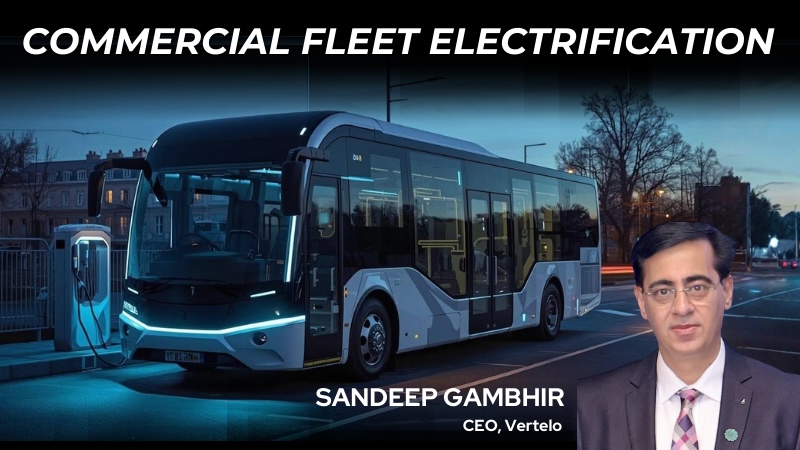
We caught up with their CEO, Sandeep Gambhir, to discuss Vertelo’s work as a fleet electrification platform and his outlook towards how the industry is positioned to evolve.
Could you please explain what Vertelo does and what your priority areas of work are?
We were conceptualized as a fleet electrification platform to enable large fleet operators to transition from ICE to electric vehicles and address the key hurdles they face in electrification. What we offer is an end-to-end solution.
- At Vertelo, operators engage with us at the very initial stages, when electrifying their fleet is still at the consideration stage. We help them assess whether electrification makes sense, identify suitable OEMs and asset classes, evaluate unit economics, and conduct route assessments.
- Once the operator decides to go electric, the next step is asset selection. A major concern for operators is whether the asset will perform reliably—this involves the right battery chemistry and size, energy and charging management. We assess route feasibility, such as Bangalore – Chennai or Mumbai–Pune, and ensure that the right asset and adequate charging infrastructure are available at the start point, midpoint, and endpoint.
- After the asset has been finalised and discussions with OEMs are complete, the next stage is financing/leasing the asset, where we engage with the operators and offer bespoke solutions and structures/tenors that are better than comparable options, making asset ownership/operations more feasible for them.
- Beyond this, we also facilitate the maintenance of the asset throughout its lifecycle through comprehensive AMC arrangements that are entirely OEM-driven, specifically for larger asset classes such as buses and trucks.
- We work with the operators to provide a comprehensive Depot setup, including charging infrastructure, office space, parking, driver facilities, and maintenance infrastructure, including pits and storage space for spare parts and their technicians. This creates a long-term relationship of 7 to 8 years with the operator, aligned with the asset lifecycle.
We handhold the operator throughout the entire journey— while financing or leasing is integral, but the overall solution goes far beyond a single transaction and what we follow is a relationship led approach with only one goal, the operator has to make money in this business, because unless the operator makes money, neither us, nor the OEM will make money in the longer run.
Are there any specific vehicle segments that you are prioritising for electrification?
We are backed by the Green Climate Fund and the Macquarie and Allianz, amongst others, and these are climate impact investors with a clear objective to mitigate the impact of climate change. Accordingly, from both a financing and an overall solution standpoint, we are focusing on asset classes that have higher levels of emissions. At this stage, we are not focused on two-wheelers or three-wheelers, which are more of a retail play. Instead, ours is a wholesale lending approach focused on the larger form factors, working with larger asset classes, large fleet operators, and larger OEMs.
Our focus segments include cars, light commercial vehicles (LCVs), buses, and trucks, along with the associated energy management and charging infrastructure.
What differentiates Vertelo from other platforms offering asset financing and fleet management solutions?
There are a few key differentiators.
- The first is the scale of capital we are bringing to this initiative. In July 25, we closed one of India’s largest funding raises for a platform of this nature, raising USD 405 million to enable Vertelo to deliver on its mandate.
- We are a pure-play electric platform with a full ecosystem approach. While there is competition in this space, it is highly fragmented. Banks and NBFCs typically operate at what we call stage three or four, focusing only on financing, which is largely transactional. Charge point operators, on the other hand, focus on charging and do not cover asset acquisition, AMC, fleet management, telematics, or battery replacement. We partner with Operators and OEMs, acting as a facilitator between them.
- While banks, NBFCs, and CPOs are our closest competitors, there is currently no comparable end-to-end platform operating at this level. The traditional mindset in India still views transactions largely from an IRR perspective. While we address that to ensure that we are competitive, we also bring significant value-added capabilities, which help us get differentiated over primarily IRR-led transactions.
- The biggest differentiator for us is our team, which includes leaders from domains such as financial services, automotive, and engineering, people who understand the entire EV ecosystem and operations, with backgrounds and experience working with large OEMs.
Our team is involved right from the conceptualisation stage and even in the manufacturing process, including presence at OEM production lines, to ensure the quality and reliability of the asset before it is dispatched from the plant. The value we bring goes well beyond marginal IRR improvements, and that’s visible to the operators, and they appreciate this partnership.
Could you share the current scale of Vertelo’s deployments?
We started our first transaction in April 2024 with Chalo. Nearly half of Chalo’s electric fleet in Mumbai was initially funded by us, and based on our relationship-led approach, we have since completed a follow-on transaction. 80% of Chalo’s electric fleet in Mumbai is now funded by us.
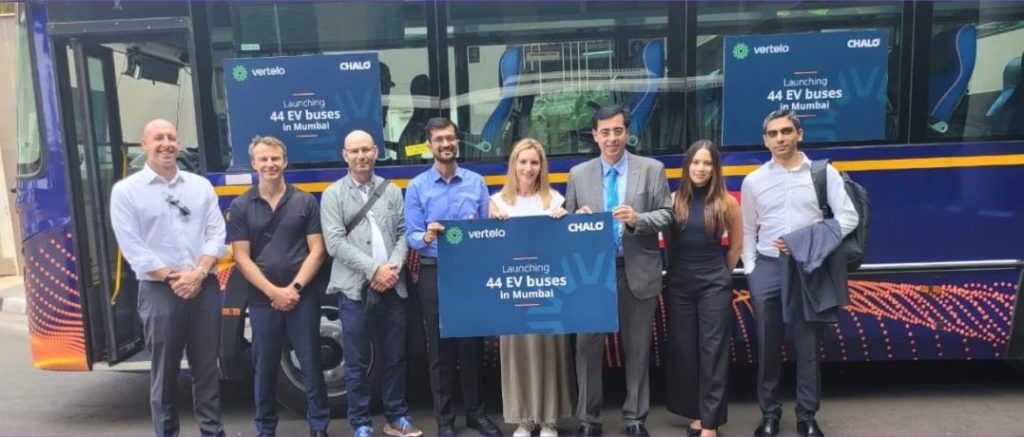
To date, we have executed ~12 transactions, covering close to 375 assets that are either already on the ground or about to be deployed. These are largely buses and cars. We have raised approximately ₹3,500 crore in total, of which approximately ₹400 crore of capital will be deployed by the end of this financial year.
We have covered multiple asset classes, including inter-city coaches and intra-city buses, cars across multiple use cases, such as B2B employee transportation and ride-hailing. We have also constructed depots, with our first depot already operational in Chennai and the second scheduled to go live in Coimbatore by the end of this month. More are in the pipeline.
Before the end of this financial year, we also expect to close a transaction in the truck segment and the battery space.
How much capital do you plan to allocate across the different aspects of the ecosystem Vertelo addresses as a platform?
We have raised USD 405 million, and we now also have an operational NBFC, having received our RBI licence towards the end of November 2025. With conservative leverage of about 3x, we can deploy between USD 1.2 billion and USD 1.6 billion. The first year is typically slower, as the focus is on building strong foundational pillars which has now happened and the real acceleration is expected in 2027 and 2028.
The industry-level pipeline is very encouraging, with several large tenders already announced and a few more upcoming soon. On the bus side alone, just the CESL tenders will account for around ₹15,000 crore of deployment over the next 2 years, and this, in addition to the state-level tenders, makes the overall opportunity close to 17,500 buses in the public transportation space in the immediate future, and more are expected on similar lines every year going forward. Logistics and trucking space present an even larger opportunity than buses.
Several Tier-1 OEMs, including Tata Motors, Ashok Leyland, IPLTech – Montra, and SANY, are launching multiple variants of e-trucks, with first-generation vehicles already operating on the road.
Given this pipeline, we are comfortable deploying USD 1.5–2 billion across asset classes over the next seven to ten years. Around 10 per cent of the capital deployment will be allocated to charging infrastructure, which we view as the backbone of the ecosystem, while the remaining capital will be deployed across vehicle assets—primarily buses and trucks, followed by cars and light commercial vehicles.
How does the platform generate revenue?
Like most platforms, we have multiple revenue streams, but our approach is relationship-led rather than transaction-led. We recognise that we may not match large banks purely on lending spreads. Instead, we embed significant value-added services around that spread, which the operator receives at no additional cost but adds to the stickiness of our relationship.
From a revenue perspective, we earn through lending spreads as well as through services. These include the end-to-end services platform, depot creation, charging infrastructure, and energy management solutions. There are also refinancing opportunities, particularly around battery replacements, which typically occur every three to five years, depending on the asset use case.
In addition, we are building a technology stack that helps operators optimise asset performance. For buses and trucks that we finance, embedded devices capture data beyond basic telematics, including power consumption, performance metrics, breakdown data, and driving patterns. This data is presented through intelligent dashboards to help operators improve utilisation and efficiency.
Overall, Vertelo’s business model is a blend of financing income and service-led revenue, anchored in long-term partnerships with fleet operators.
How do you view end-of-life vehicle management, and how critical is it to your overall business planning and profitability?
We facilitate the management and maintenance of the asset through its entire lifecycle, largely in partnership with OEMs. As part of our financing or leasing arrangements, we mandate end-to-end AMC, particularly for high-voltage systems and batteries, where OEM expertise is critical. Operators are not permitted to service these components independently, while other maintenance activities can be handled by fleet operators after OEM-led training.
More than end-of-life sales value realisation, enhancing the useful life of the asset, including battery life, is a key focus. For a bus with a useful life of 10–12 years, batteries may be replaced twice during its lifecycle, depending upon the use case. Through proper maintenance and monitoring, the life of the asset is optimised, enhancing the useful life, thereby reducing the Residual Value risk. As we go along, there will be alternative use cases for returned batteries and secondary applications, such as energy storage, which will help defer residual value (RV) realisation by extending the economic life of the asset.
While secondary battery use cases are expected to become clearer over the next 2 to 3 years, full end-of-life vehicle management remains a longer-term consideration, likely 7 to 8 years away. Since EVs have fewer components, battery replacement alone can significantly extend asset life and reduce RV risk.
Residual value estimation for EVs is still evolving and remains uncertain, even for manufacturers. India does not yet have electric buses that have completed their primary use cycle. With primary asset lives of eight to ten years, any RV estimate today would be largely speculative, and the same applies to electric cars. As a result, when assets are held on our balance sheet, we assume conservative residual values due to the lack of reliable data. Our approach to mitigating RV risk focuses on extending asset life including batteries replacement through optimizing performance using a data-driven approach and intelligent asset management.
As we enter 2026, what are Vertelo’s expansion plans for the year? Where do you see Vertelo positioned in the commercial fleet space over time?
We are very bullish about the year ahead and the next couple of years. A large part of this confidence comes from the government’s role as a key facilitator and a strong supporter of the emerging EV Landscape. Policy clarity has been consistent, and recent tenders clearly indicate the government’s direction on electrification across segments. From Vertelo’s standpoint, we are entering the next year with a strong pipeline. Many of the earlier contracts will translate into on-the-ground deployments in 2026.
From around 375 vehicles on our platform today, we expect to cross 1,000 buses within the next financial year. We expect to close this year with ~100 electric trucks on our balance sheet, with significant growth thereafter. Depot infrastructure across cities is also progressing steadily.
While Vertelo may be perceived as a startup, we began with strong conviction and capital backing, having raised significant funds upfront. The primary risk now is execution—deploying assets, lending responsibly, and ensuring asset and portfolio performance. The market is large and here to stay, but we are in no hurry to get it wrong. Rather than aggressively chasing scale, we are focused on building a strong foundation that will enable sustainable growth in the years ahead.
This interview was first published in EVreporter Jan 2026 magazine.
Also read: Macquarie helps mobilise $405M investment for Vertelo
Subscribe & Stay Informed
Subscribe today for free and stay on top of latest developments in EV domain.